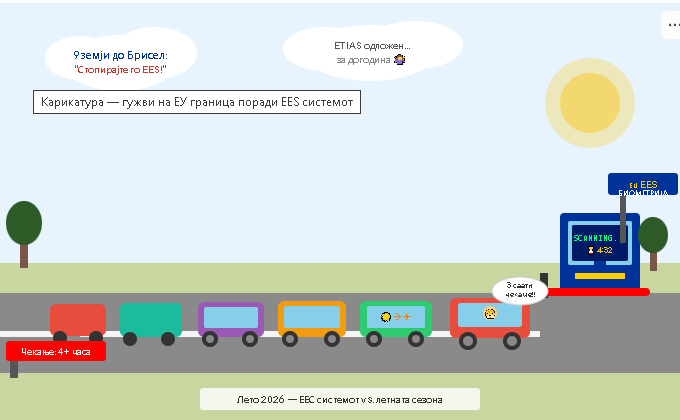
Nine EU Countries Demand EES Rollback as Border Queues Ruin Summer Holidays
Belgium, France, Germany, Greece, Italy, Malta, the Netherlands, Portugal and Switzerland have written to Brussels demanding the EU extend emergency flexibility for its Entry/Exit System, which has caused hours-long border queues across Europe's busiest airports this summer.
A coalition of nine European countries is pushing back against Brussels over the bloc's new biometric border control system, warning that the Entry/Exit System (EES) is simply not ready to operate at full capacity — and that the chaos at Europe's borders this summer proves it.
In a joint letter dated 7 July, seen by POLITICO, Belgium, France, Germany, Greece, Italy, Malta, the Netherlands, Portugal and Switzerland urged EU Commissioner for Home Affairs Magnus Brunner to extend the system's built-in emergency flexibility mechanism beyond its scheduled expiry date of 6 September 2026. Without that extension, border authorities will lose the ability to pause biometric checks when queues become unmanageable.
What Is EES — and Why Is It Causing Chaos?
The Entry/Exit System is the EU's new digital border management tool, designed to automatically register when non-EU nationals enter and exit the Schengen zone. Every traveller from a third country — including Britons and Americans — must have their fingerprints and facial image scanned at the border. It was introduced to improve security and track overstays, replacing the old analogue passport stamp system.
But the rollout this summer has been deeply turbulent. Italy, Greece, Spain, Portugal and Belgium have all experienced major queues at their busiest airports and sea ports, with some passengers waiting four hours or more. Some travellers missed their flights entirely.
⏱️ Waiting times: up to 4+ hours at peak airports
✈️ Passengers missing flights in Italy, Greece, Spain, Portugal, Belgium
🔴 "20 problematic points" identified across 1,500 EU border crossings
📍 One small airport: 3,000 passengers arrived in one hour — only 4 biometric booths available
🌍 Most affected: UK, US, and other third-country travellers
Industry Calls for Suspension
The aviation sector has been vocal in its criticism. Last week, representatives from airlines, airports and the International Air Transport Association (IATA) called for EES to be suspended until next summer, arguing the system is causing unacceptable disruption to passengers during peak travel season.
EU authorities rejected a full suspension. An official stated that a complete halt was "not possible" and "not necessary", and warned that inconsistent application of EES would create an "unfortunate situation" where passengers crossing a non-EES border could be wrongly flagged as overstayers when they later try to enter via an EES-enabled crossing.
ETIAS Delayed Until Next Year
Amid the EES turmoil, the Financial Times has reported that the related ETIAS system — the EU's equivalent of the American ESTA travel authorisation — will be delayed until 2027. The €20 pre-travel authorisation system was designed to complement EES, but the agency responsible, EU-Lisa, has quietly shelved it.
An unnamed source told the FT the reasoning was blunt: "Let's get EES sorted first before we put in another system that doubles the queue again." EU-Lisa's board reviewed the matter in June, but no new timeline has been announced. A possible restart of the process could come as early as September, when the board meets again.
For Macedonia and the Western Balkans, the EES chaos matters directly: hundreds of thousands of Macedonian citizens travel to the EU each summer as third-country nationals, meaning they are among those who must have their biometrics scanned. Those who have encountered the new system at Greek or Italian airports this summer know exactly what the nine-country coalition is complaining about.
MKNews Hub · Свет · 9 July 2026