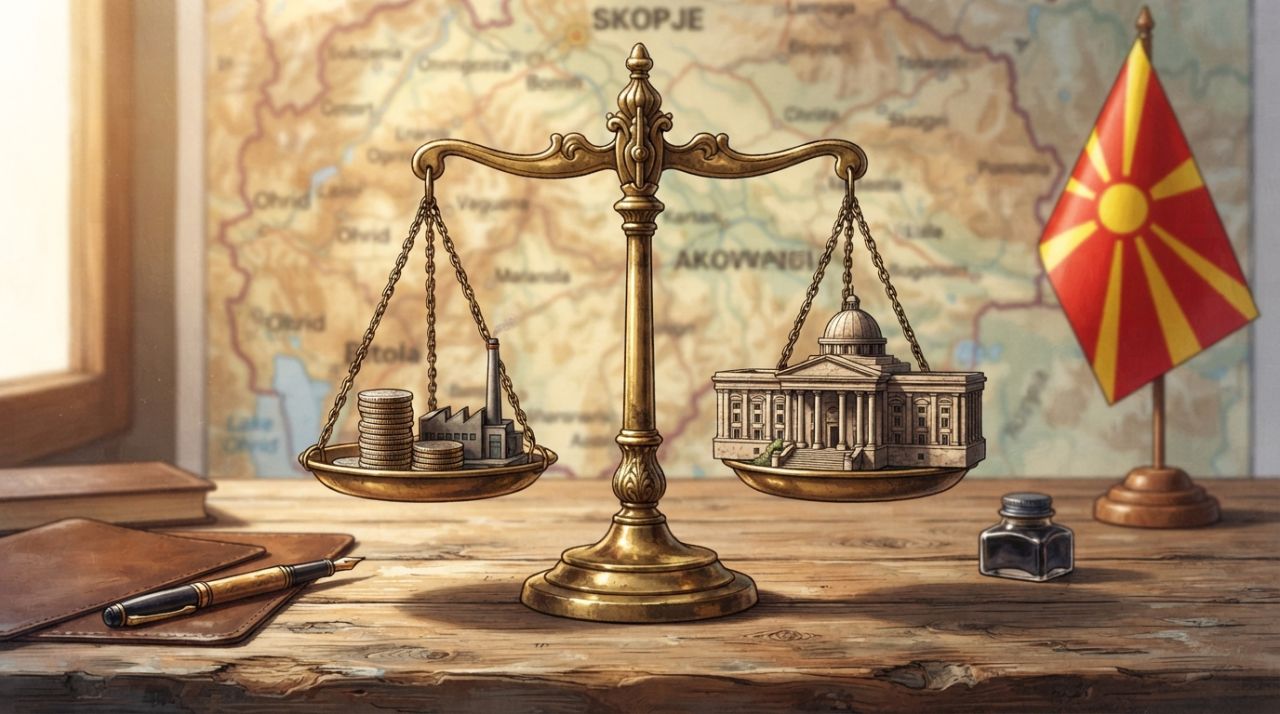
Illustration: AI-generated
Right-wing economics means less state, not fewer rules
Column: The right once defended the freedom of the market, but today it increasingly asks for tariffs, subsidies and state projects. Where does Macedonia stand in that story?
What does it actually mean to be on the right when we talk about money, taxes and jobs, and how much of that do we see here?
Labels stick easily in politics. Right, left, conservative, progressive. But once we take away the flags and the speeches, one simple question remains: who earns the money, who spends it and who decides about it?

The classical right in economics has a clear answer. Money is best spent by the person who earned it. The state should be the referee on the pitch, not a player. Low and simple taxes, secure private property, free trade, a budget that does not live on debt and a market where the better one wins, not the better connected one.
This is not a new idea. Adam Smith wrote about the invisible hand of the market as early as 1776. In 1944 Friedrich Hayek warned that a state that plans everything eventually starts deciding about people’s freedom too. In the 1980s Margaret Thatcher and Ronald Reagan turned those ideas into policy: privatisation, lower taxes and less regulation.
Here lies the first misunderstanding. Right does not mean without rules. A market without rules is not a free market but a jungle in which the strongest tramples the smaller ones. A genuine right-wing economy needs a strong state in a few things: fast and independent courts, protection of competition, predictable laws and a clean administration. And a modest state in everything else.
Macedonia has its own right-wing chapters. The 10 percent flat tax, introduced almost two decades ago, was one of the clearest right-wing economic decisions in the region. Simple, understandable and hard to avoid. The technological industrial development zones and the drive for foreign investors brought factories and thousands of jobs. The attempt at a progressive tax in 2019 was short-lived, and the state soon returned to the flat rate.
But there is also a second misunderstanding, and it is not only Macedonian. In the Balkans all parties, whether they call themselves right or left, are very fond of the state. Public sector jobs, subsidies, state capital projects, help for every sector that raises its voice. It brings votes, but rarely productivity. When the state is the biggest employer and the biggest buyer, the private businessman stops looking to the market and starts looking to the ministry.
The world today makes the question even more complicated. The American right, which defended free trade for decades, is now building tariff walls. Part of the European right wants protection for domestic producers and more state intervention. The right is moving away from Smith and Hayek and closer to economic nationalism. Whether this is a new right or an old left under a new flag, time will tell.
As an entrepreneur working in energy and digital media, I do not see right-wing economics in textbooks but in everyday life. It is in how many days you need for a permit, whether the rules will be the same next year, whether a contract with the state means anything, whether a court will decide within a reasonable time and whether you pay one fee or five different charges for the same thing.
That is why I think the most important question for the right here is not how loud it is on identity issues, but how brave it is on economic ones. Fewer and simpler charges. A digital administration without counters and without “someone you know.” Public procurement where the best offer wins. A state that builds roads, schools and hospitals and does not compete with companies.
No government, whichever it is, can do this overnight. But the direction matters. A right that believes in its citizens leaves the money in their pockets and trusts that they know what to do with it. A right that does not believe in them collects the money and then decides whom to give it back to.
That is the difference between a free market and a market by permission. Macedonia deserves the first.
Right does not mean less state for everyone, but less state where it gets in the way and more state where it protects.
 Column · Bojan Vasilevski, founder and editor · November 26, 2026
The views expressed in this column are the author’s personal views.
MKNews Hub · Macedonia · November 26, 2026
