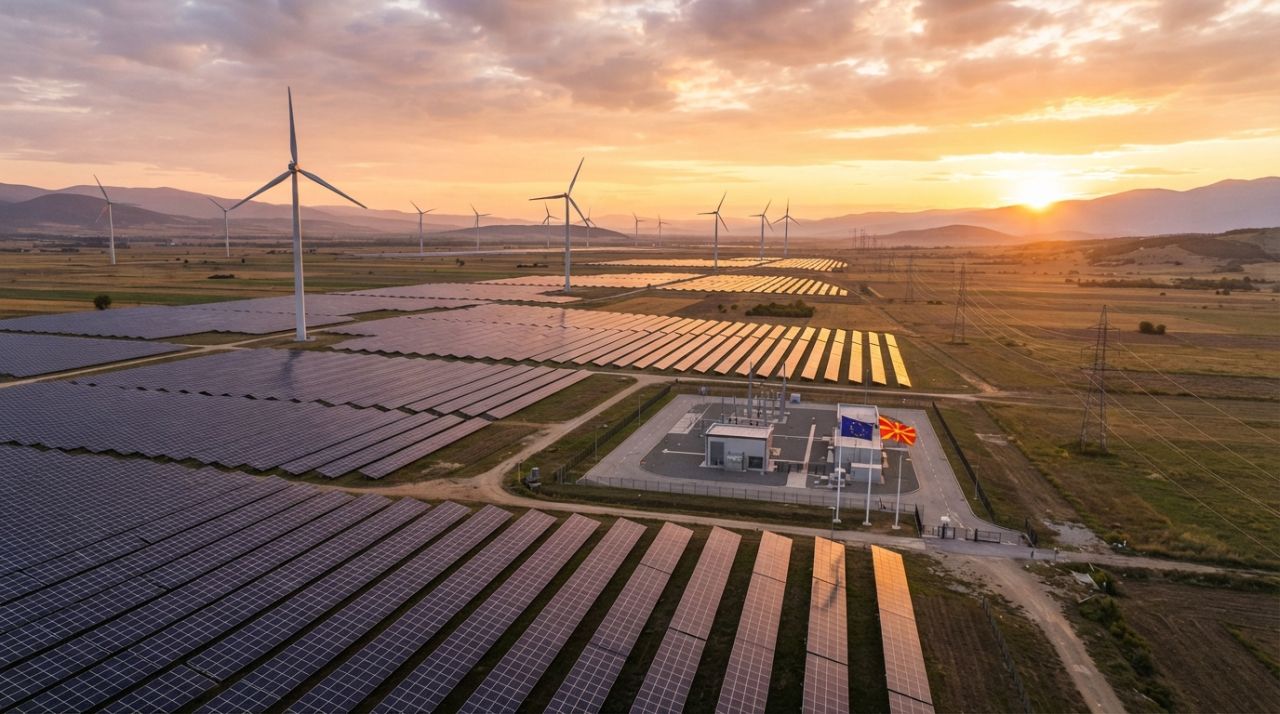
North Macedonia Approved 67 Energy Facilities of About 4.4 Gigawatts, and the Power Exchange Got an Intraday Market
The 2026 plan is more than twice the total renewable capacity at the end of 2024. Still, an approved plan is not a built power plant.
Skopje – For 2026 North Macedonia approved a plan to build 67 energy facilities with a total capacity of about 4.4 gigawatts, and in May it also got an intraday electricity market. Both facts are part of the picture of energy drawn by the European Commission’s 2026 report, published on November 4.
The annual plan for building energy facilities was presented by Minister of Energy, Mining and Mineral Resources Sanja Bozhinovska. It covers 59 solar plants with over 3.01 gigawatts, seven wind farms with 908 megawatts and one cogeneration gas plant of 495 megawatts. Besides generation, 96 storage facilities were approved, with 2.03 gigawatts and 4,961 megawatt-hours.

According to the estimate, the generating capacity is worth about 3.73 billion euros, and storage close to two billion. The plan, Bozhinovska said, sets “higher standards, stricter control and clear rules” to protect energy security, the environment and the public interest.
How big the leap is shows when the plan is compared with what exists. At the end of 2024 total renewable capacity in the country was 1.63 gigawatts, according to IRENA data. The approved solar and wind capacity is 3.92 gigawatts, or about 2.4 times more (our calculation).
Here we reach the limit of the good news. An approved plan is not a built power plant, and deadlines for construction and commissioning have not been announced. The goal remains reaching at least 40 percent renewables in total consumption by 2030 and 45 percent by 2040.
The second pillar is the market. On May 6 the operator MEMO launched the intraday market, three years after the day-ahead market. The trading platforms are provided by Slovenia’s BSP exchange and M7 of Germany’s Deutsche Börse. Trading volume is growing: 335 gigawatt-hours by the end of 2023, about 970 in 2024 and over 1.37 terawatt-hours last year. In the first quarter this year the volume is 19 percent higher than in the same period last year.
“From today our market not only plans for tomorrow, it operates in real time,” said MEMO CEO Zoran Gjorgjievski. Bozhinovska called it “just the starting point for our full integration into the European energy family”, with the market’s coupling with the EU as the next step.
Gjorgjievski also sounded a warning. EU measures such as the carbon border adjustment mechanism, CBAM, according to him may burden domestic producers and affect liquidity. The green transition, he added, “must be fair, gradual and economically sustainable”.
The report also mentions the new law on renewable energy sources, adopted in July 2026 and aligned with the European RED II directive.
As in other chapters, a good rating in energy does not change the condition for the negotiations. “No progress was made towards adopting the relevant constitutional changes,” the report states. Progress exists, while the key to opening the negotiations remains the constitutional changes agreed in the Council Conclusions of 2022.
MKNews Hub · Macedonia · November 8, 2026
