Siljanovska in Budapest: thanks to Hungary for its support, enlargement should be credible and merit-based
The president met Hungary's president on the 70th anniversary of the 1956 revolution, with no agreements announced.
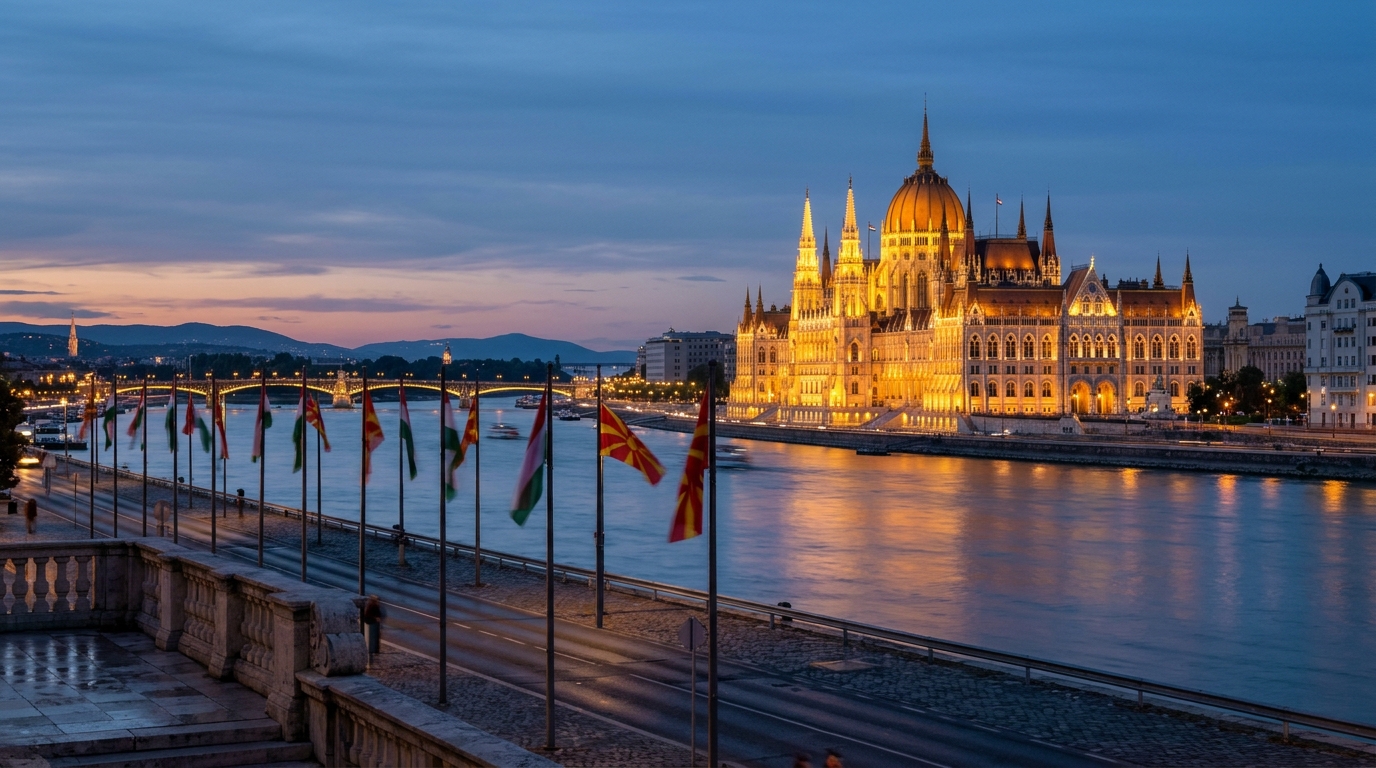
President Gordana Siljanovska-Davkova was in Budapest on October 23 for the 70th anniversary of the 1956 Hungarian Revolution. According to the Albanian portal Albeu, she met Hungarian President András Baca, who was elected in August 2026, and attended a working lunch he hosted for heads of delegation.
Siljanovska-Davkova thanked Hungary for its “principled stance and strong support” for North Macedonia's European integration and for its active role in the Visegrád Group. She said enlargement should be based on a credible process, with assessments on merit and under the Copenhagen criteria.

The two sides discussed strengthening ties through political dialogue, reciprocal visits and economic cooperation, as well as current geopolitical challenges. The report carries no direct statement from President Baca. The Hungarian position is thus described through the Macedonian side's account, not his words.
What does this support mean? Hungary is a member of the EU and the Visegrád Group and has a say in enlargement processes, where decisions are taken by consensus of all member states. Any public support is therefore politically valuable for Skopje. Still, the main obstacle on the Macedonian path remains the dispute with Bulgaria and the demand for a constitutional amendment, which Hungary cannot resolve alone.
What is the president's role? Under the Constitution, the president of North Macedonia has a representative role, while foreign policy is run by the government. The meeting is therefore important as a diplomatic signal, but it brings no binding decisions. In addition, the message of credible, merit-based enlargement fits the government's position but differs from Brussels' emphasis on concrete steps.
What is not known? It is not known whether the meeting agreed on concrete projects, economic agreements or reciprocal visits with dates. Nor is it known what the Hungarian president said or wished regarding the Macedonian path. It is also not known whether Hungary plans to use its vote to speed up the opening of the Macedonian cluster.
What does it mean? The visit is a diplomatic move that confirms good bilateral relations, but does not change the substance of the European path. The real contribution will be measured by whether support from Budapest turns into concrete steps in the EU Council.
MKNews Hub · Macedonia · October 25, 2026
