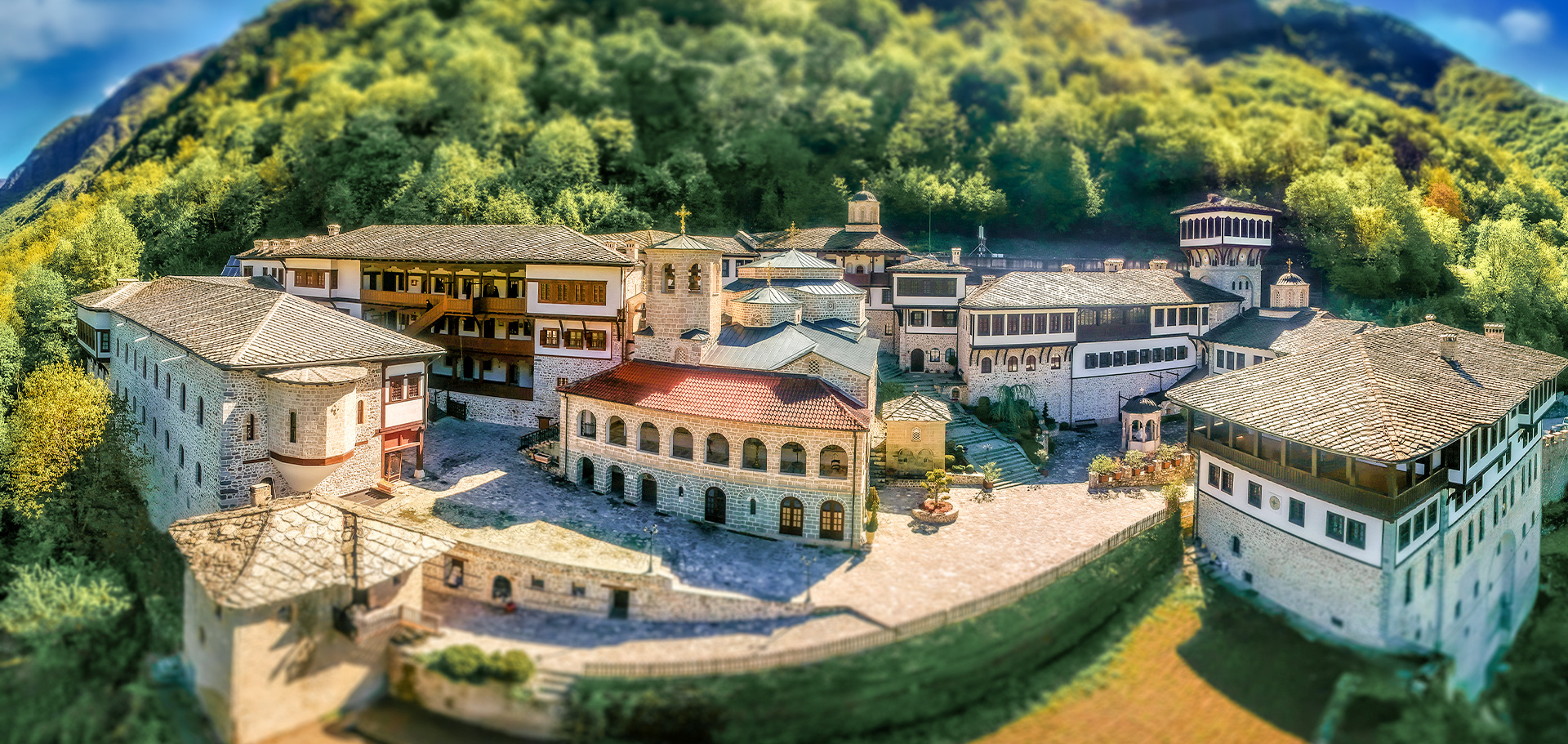
Did You Know? The Bigorski Monastery Iconostasis Has No Equal Anywhere in the World
Carved from walnut wood over six years in the 1830s, this masterpiece deep in the Radika canyon survives at a monastery whose miraculous icon outlasted centuries of destruction.
Deep in the canyon of the Radika River, on travertine cliffs beneath Mount Bistra near the village of Rostuše, stands one of Macedonia's most revered Orthodox monasteries — Sveti Jovan Bigorski. According to tradition, its history begins in 1020, when the monk Jovan Debranin, later the first Archbishop of Ohrid, found the miraculous icon of St. John the Baptist on that very spot and built a church around it.
Named for the Rock It Stands On
The monastery takes its name from "bigor" — the travertine rock it's built from, formed over centuries by mineral deposits from the river's water. Across a thousand years of existence, the monastery has been destroyed, burned and rebuilt more than once — and the one object that has always survived every act of destruction is the miraculous icon of St. John the Baptist itself.

An Iconostasis Without Equal
What the monastery is best known for outside religious circles is its iconostasis — a woodcarving masterpiece created between 1829 and 1835 by the workshop of Mijak master carver Petre Filipovski-Garkata from the village of Gari, together with his brother Marko, Makarij Frčkovski from Galičnik, and Avram Dičov with his sons. Carved from walnut wood and divided into six horizontal bands, the iconostasis is unique for its use of human figures interwoven with animals, birds and plant ornaments — grapevines, daffodils, roses — in a combination experts say has no equal anywhere in the world.
From Neglect to Revival
The monastery's history hasn't been all glory — after the death of its last abbot, Father Spiridon, in 1948, monastic life stopped entirely for nearly five decades. During the communist era, the church was reduced to functioning as a plain museum, with no services and no upkeep. Monastic life was only revived in 1995, with the arrival of the current abbot, Archimandrite Partenij, who gradually restored both the spiritual and physical life of the community.
🔵 The monastery is over 1,000 years old, founded according to tradition in 1020.
🔵 The icon of St. John the Baptist is the only object to survive every destruction across the centuries.
🔵 The iconostasis was carved entirely from walnut wood over 6 years (1829-1835).
🔵 Monastic life stopped entirely from 1948 until 1995.
MKNews Hub · "Did You Know?" Series · Episode 9 · August 21, 2026
