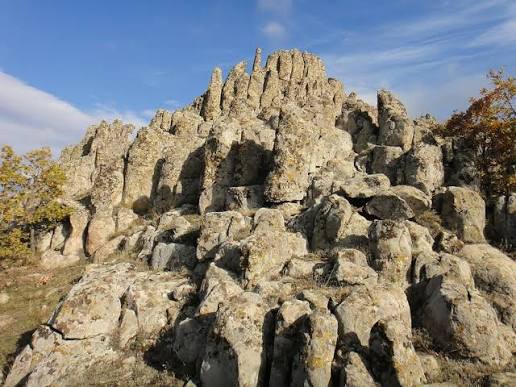
Kokino — the Bronze Age Observatory NASA Ranked Among the World's Oldest
A rocky hilltop near Kumanovo doesn't look like much at first glance. But nearly 4,000 years ago, Bronze Age astronomers used it to track the sun and moon with startling precision — precise enough that NASA later ranked it among the four oldest observatories on Earth.
About 35 kilometers northeast of Kumanovo, on a volcanic hill known as Tatikjev Kamen near the village of Kokino, sits one of the most remarkable archaeological sites in the Balkans — a Bronze Age megalithic observatory that predates written history in this region.
Discovered in 2001
The site was uncovered in 2001 in the Staro Nagoričane municipality, sitting roughly 1,000 meters above sea level. What first looked like an unusual Bronze Age settlement turned out to be something far more specific: archaeologists and astronomers determined that its stone markers had been deliberately placed to track the rising positions of the sun and moon across the year.

Fourth on NASA's List
The archaeoastronomical analysis — led by physicist Gjore Cenev together with a team from the Kumanovo Museum headed by Jovica Stankovski — showed the site had been used to construct a lunar calendar nearly 3,800 years ago. The findings were precise enough that in 2005, NASA placed Kokino fourth on its list of the world's oldest observatories, behind only Abu Simbel in Egypt, Stonehenge in the United Kingdom and Angkor Wat in Cambodia — making it the oldest known observatory in the Balkans.
Stone Markers That Still Work
The observatory is built from jagged volcanic rock arranged across several stepped levels, with stone "thrones" at the summit facing east — believed to have been reserved for the community's most important figures to observe the sky. Researchers identified separate stone markers for the summer solstice, the spring and autumn equinoxes, and the winter solstice. The summer solstice marker survives in the best condition; the winter solstice marker shows the most damage, likely from earthquakes over the millennia.
Because Earth's axis slowly shifts over time — a phenomenon called precession — the sun today rises slightly off from where the ancient markers point. Rather than undermining the site's authenticity, that small drift actually confirms it: the deviation matches exactly what astronomers would calculate given how much time has passed, proof the markers were placed with real precision thousands of years ago.
🔵 Kokino is roughly 3,800 years old — older than many of Europe's famous stone monuments.
🔵 NASA's 2005 ranking places it 4th in the world, just behind Stonehenge.
🔵 It's the oldest known observatory anywhere in the Balkans.
🔵 Its stone "thrones" at the summit faced east, likely reserved for the community's leaders.
MKNews Hub · "Did You Know?" Series · Episode 4 · August 14, 2026
